 Deutsch
Disc Film
Disc film was introduced by Kodak in 1982-1998 as a compact, drop‑in photographic system using a flat plastic disc containing fifteen 8 × 10.5 mm negatives. Although discontinued many years ago, Disc cameras remain in use, and MS Hobbies continues to support Disc film users in the United Kingdom with film supply, processing and technical guidance.
Disc Film Stock
Disc film is no longer manufactured. MS Hobbies supplies carefully stored expired Kodak Disc film for specialist and documentary use.
- Original Kodak Disc film (expired stock)
- Supplied for legacy and experimental photography
As with all expired film, results depend on storage history and camera condition. Disc film offers limited exposure latitude compared with modern formats.
If your disc film looks likes the left-hand side, then it needs processing and scanning £17.50, otherwise, scanning only £12.50
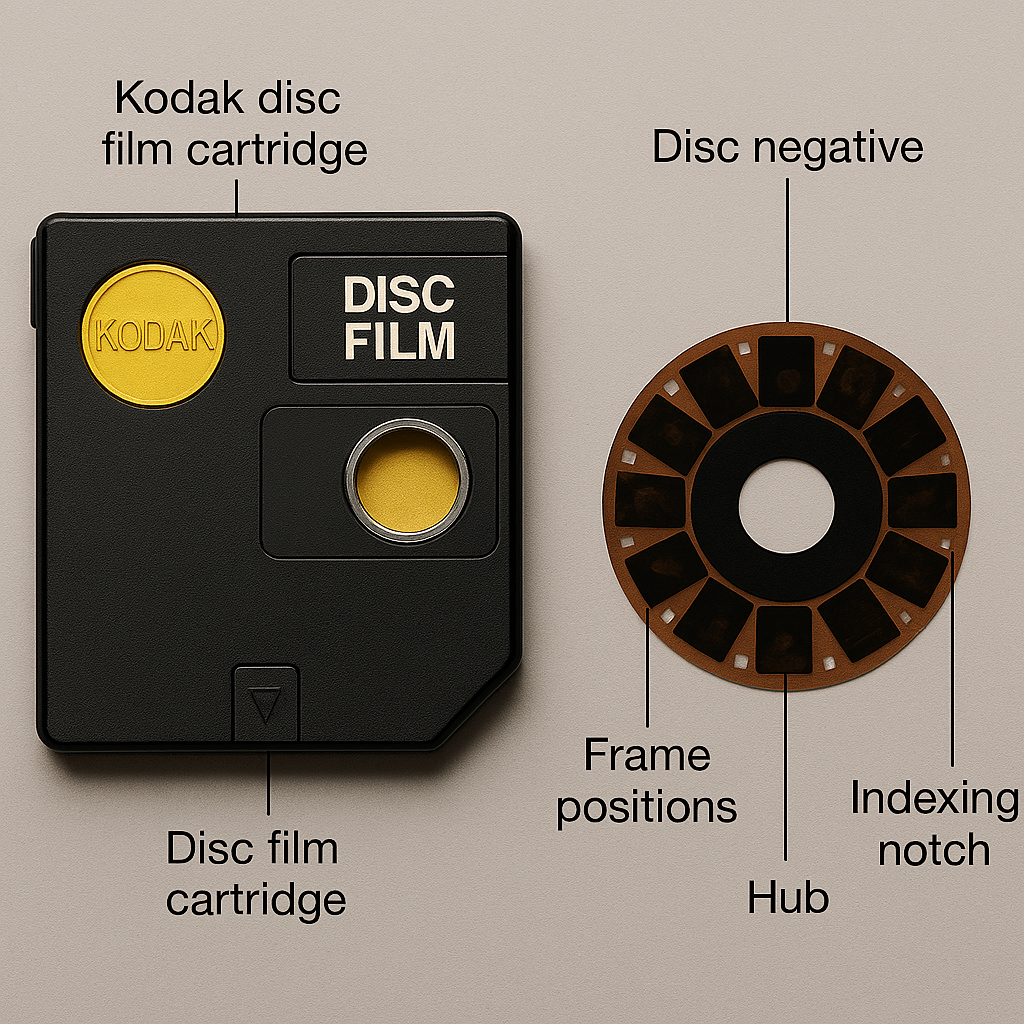
Disc Film Processing (UK)
MS Hobbies offers Disc film processing for UK customers using adapted procedures appropriate to the Disc format. £17.50 for processing and scanning, £12.50 for scanning already processed films.
- Black & white processing
- Colour processing where practical
- Scanning to JPEG or TIFF
Due to the very small negative size, scanning is optimised for documentation and reference rather than enlargement.
Disc film processing and scanning orders are submitted using the APS, Disc & Minox Processing and Scanning Order Form (PDF).
Disc Cameras
Disc cameras were produced primarily in the early 1980s. Most designs use programmed exposure and rely heavily on correct battery voltage for reliable operation.
Disc Camera Models (1982–1984)
| Manufacturer | Model | Year | Battery Type | Features |
|---|---|---|---|---|
| Kodak | Disc 4000 | 1982 | Model‑specific (replaceable cells) | Fixed focus, programmed exposure, built‑in flash |
| Kodak | Disc 6000 | 1982 | Model‑specific (replaceable cells) | Improved lens, programmed exposure, built‑in flash |
| Kodak | Disc 8000 | 1983 | Model‑specific (replaceable cells) | Autofocus, programmed exposure, built‑in flash |
| Minolta | Disc‑5 | 1983 | Internal lithium battery (sealed, not field‑replaceable) | Programmed exposure |
| Minolta | Disc‑7 | 1983 | Internal lithium battery (sealed, not field‑replaceable) | Programmed exposure |
Battery types vary by model. Some Disc cameras use replaceable cells, while others use sealed internal lithium batteries that are no longer serviceable.
Battery types vary by manufacturer and model. Some Disc cameras use standard replaceable cells, while others use sealed internal lithium batteries.
Battery leakage, corroded contacts, and depleted sealed packs are common causes of Disc camera failure today.
All mainstream Disc cameras use standard AA alkaline batteries. No Disc cameras require mercury PX cells or specialist lithium substitutes.
Battery leakage and corroded contacts are the most common causes of Disc camera failure today.
Practical Limitations
Disc photography was designed for convenience rather than image quality. Users should be aware of the following constraints:
- Very small negative size
- Limited suitability for enlargement
- Strong dependence on camera condition and battery voltage
Despite these limitations, Disc photography remains of historical and documentary interest.
Ordering & Enquiries
Film availability and processing options vary. Please contact MS Hobbies before ordering to confirm current stock and turnaround times.
Email: info@mshobbies.co.uk
Telephone: +44 (0)20 3 971 8827
Revision: 26 February 2026 (MSH‑DISC‑UK‑02)